

[ad_1]
The Venezuelan coup opens the gates to a new era of imperial plunder.
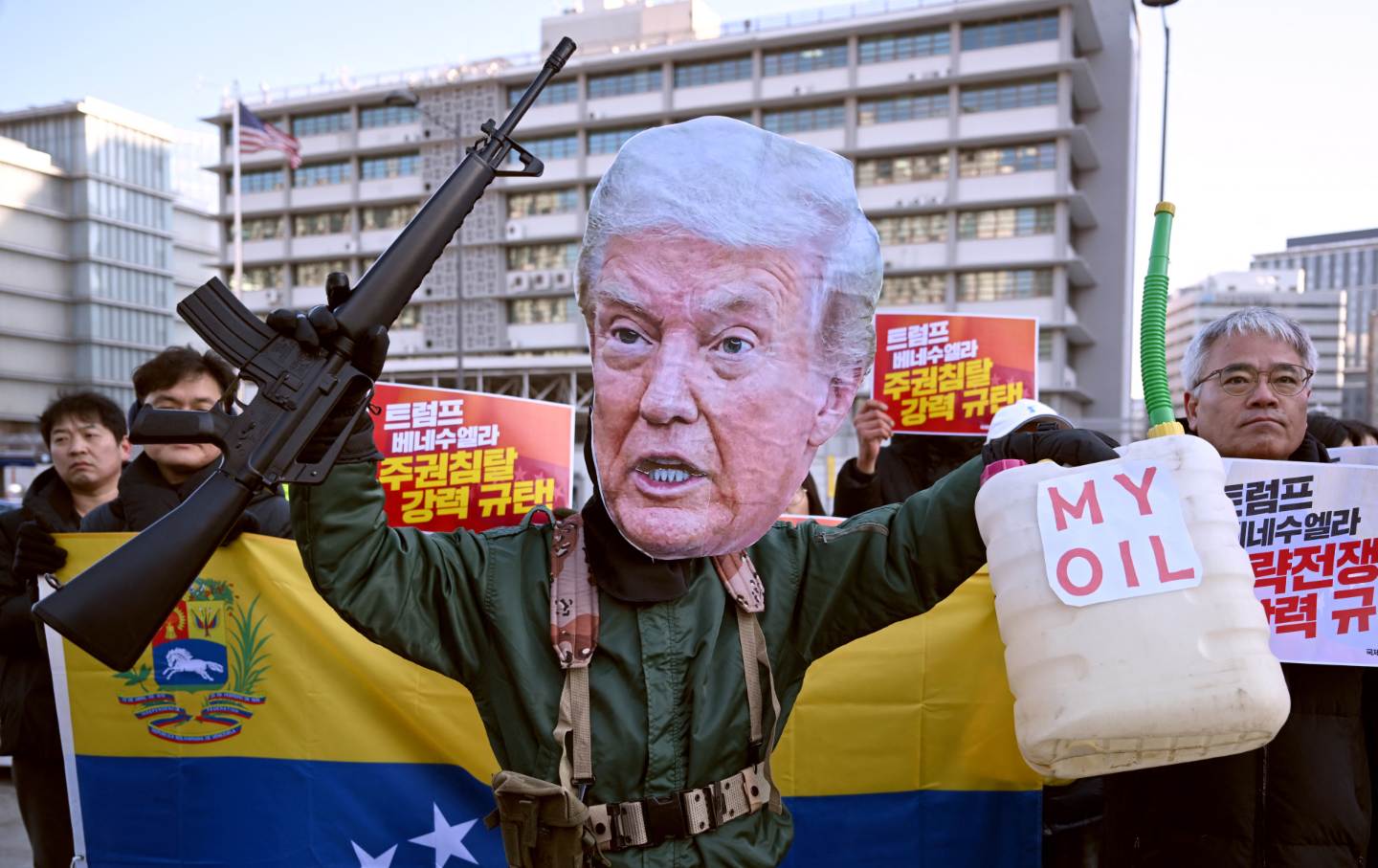
Protesters participate in a rally near the US embassy to denounce the US attack on Venezuela on January 5, 2026, in Seoul, South Korea.
(Chung Sung-Jun / Getty Images)
Donald Trump started 2026 with a coup and a kidnapping, using the American military to abduct Venezuelan President Nicolás Maduro and his wife, Celia Flores. Trump’s violation of Venezuelan sovereignty is a crime against both the American Constitution and international law. More terrifyingly, it appears to be just the beginning.
On Saturday, Trump gloated to Fox News, “This incredible thing last night. We have to do it again [in other countries]. We can do it again, too. Nobody can stop us.” Trump is, unfortunately, correct. The normal check on an out-of-control president is Congress, but the Republicans who control it are all too eager to abdicate their constitutional responsibilities. Another potential restraining force is the international community. But both America’s biggest allies and biggest rivals (notably China and Russia) have signaled that they will offer no more than pro forma rhetorical objections to Trump’s nakedly imperialist foreign policy.
As a result, Trump is drunk on war. The spectacle of violence on behalf of naked plunder gives him a sense of power. During his press conference on Saturday, Trump exulted, “Overwhelming American military power, air, land, and sea was used to launch a spectacular assault, and it was a—an assault like people have not seen since World War II.” With his domestic support flailing and his reputation threatened by new revelations of his ties to the late pedophile Jeffrey Epstein, Trump is turning to foreign policy as an arena where he can still flex his muscles. This is especially true in the Western Hemisphere, where the United States has long enjoyed a de facto sphere of influence under the dubious justification of the Monroe Doctrine.
In his press conference, Trump noted, “Monroe Doctrine is a, a big deal, but we’ve superseded it by a lot. By a real lot. They now call it the ‘Donroe’ Document.” The Donroe Document (or Donroe Doctrine) is in fact nothing less than naked imperialism, based on the idea that the Western Hemisphere is the de facto property of the United States. In the press conference, Trump repeatedly justified the coup on Venezuela as necessary because the nation’s oil resources belong to American companies. “We’re going to run the country until such time as we can do a safe, proper, and judicious transition,” Trump said. He added, “Massive oil infrastructure was taken like we were babies, so we didn’t do anything about it. I would have done something about it. America will never allow foreign powers to rob our people or drive us back into and out of our own hemisphere.”
After Venezuela, Trump is eyeing other nations in the Western Hemisphere to attack. In an interview with The Atlantic on Sunday, he said, “We do need Greenland, absolutely.” He said Greenland was “surrounded by Russian and Chinese ships.” In his Fox News interview, Trump said, “Something is going to have to be done with Mexico.” Trump’s secretary of state, Marco Rubio, on Sunday told Meet the Press that “the Cuban government is a huge problem” and “they are in a lot of trouble.” Trump also threatened military action against Colombia and Iran.
Trump’s bravado needs to be distinguished from what he is actually capable of. The focus on the Western Hemisphere, where the US has overwhelming military superiority and where no rival power possesses nuclear weapons, is itself a sign of a superpower in retreat. Trump’s recent National Security Strategy, released in November, notably eschewed great-power completion with China and Russia. As journalist Noah Kulwin argues, “American imperial hegemony appears as unchecked as ever but this behavior of a power in decline, looking for weaker and weaker opponents to beat up on in lieu of any other national project.”
Current Issue
The Venezuela coup was a violent spectacle, but one that created a greater perception of change than is merited by reality. Aside from Maduro and his wife, Trump left the existing government of Venezuela in place, with Vice President Delcy Rodriguez now in charge. Trump dismissed Venezuelan opposition leader María Corina Machado as “a very nice woman” lacking respect within the country. In other words, what Trump achieved was leadership change rather than regime change, likely with the connivance of the Venezuelan political elite. Contra Trump, the United States will not be directly running Venezuela on the ground; rather, it will continue to use coercion to achieve policy goals. Venezuela will be under the thumb of the US more than ever and an open playground for the US business community, but these were all goals that likely could have been achieved by making a deal with Maduro (as some in the Trump administration hoped for as recently as last summer).
The Venezuelan coup created the type of ultraviolent spectacle that Trump revels in, but it had little rationale other than providing an advertisement for Trump’s vision of a world of unbridled imperial plunder divided into spheres of influence.
This imperialism is itself destabilizing and worth opposing. If the world is to survive the 21st century’s confrontation with climate change, it’ll need more international cooperation than ever before. Trump’s sphere-of-influence policy, in addition to his reactionary focus on bolstering fossil fuel production, is a direct subversion of any such cooperative future.
Unfortunately, there’s little sign of any serious political challenge to Trump’s project. Republicans are a lost cause. Moreover, while many congressional Democrats have been admirably forthright in attacking Trump’s foreign policy, their leaders, such as Chuck Schumer and Hakeem Jeffries, have been more muted, often focusing on procedural objections such as the need for congressional oversight rather than making a substantive critique. Centrist Democrats are even anonymously arguing that their party should support the capture of Maduro.
European leaders have offered a muted and contradictory response to the coup in Venezuela, mixing condemnation of Maduro as a tyrant with pious expressions of faith in international law. Matt Duss, vice president of the Center for International Policy, warns that “the lame European responses to Trump’s Venezuela war are basically an invitation to just go ahead and take Greenland.”
The real check on Trump’s imperialism will come not from existing political elites but from mass protests and organizing, which might in turn help shift elite opinion. According to a YouGov poll, the Venezuelan war is as unpopular as Trump himself and has little support outside the MAGA base. The poll shows that 46 percent of the population oppose the war as against 39 percent who support it, a division that breaks down along partisan lines. These numbers are striking, because US wars are usually most popular at the start. This coup starts with low approval, and is likely to sink lower when it turns out to have paltry benefits other than for the business leaders—including Charles Myers, a major donor to the Democratic Party—salivating at money-making opportunities in a more Trump-compliant Venezuela (although even those business leaders seem reluctant to make the kinds of capital investments that Trump is calling for). Outside the US, there have been mass protests against the kidnapping of Maduro.
The Venezuela coup is not only unpopular—it highlights all the worst tendencies of lawlessness that make Trump himself unpopular. Organizing an anti-war movement in the US is hard in the absence of significant US casualties, but Trump’s unpopularity has already produced massive protests. The anti-war argument can both feed on this resistance to Trump and offer the resistance an even more compelling reason to oppose this criminal presidency.
More from The Nation
Might is right is the philosophy behind the Trump administration’s decision to kidnap Nicolás Maduro.
The pundits straining to seek coherence in the new interventionist “Donroe doctrine” would do well to look back to Trump’s roots in New York real estate
Her victory was won by the precariat: renters, transit riders, and democratic socialists who rallied, doorbelled, created social media, and registered new voters.
[ad_2]
